Exit Plan 101’s: Key Inclusions You Need to Have

A common question we get asked is “What is an exit plan and why do I need one?”

We find that most business owners are working away, growing their businesses, without ever thinking about what happens at the end?…

The end of what? You might be thinking…

Well, the end of your business’s life!

Realistically, there are only 4 ways you will exit a business:

  1. You sell it – either a share sale, merger, acquisition or IPO
  2. You pass it on – to a family member, as an example
  3. You liquidate – or worse, file for bankruptcy.
  4. You kick the bucket!

Thats it!

What we also find is that business owners are rarely prepared for any of the above.

This is why you need a comprehensive Exit Plan (or exit strategy) that prepares you AND the business for whenever you are ready to move on.

A well-crafted exit plan or strategy should include the following:

  • a decision on what you will do with your business (sale/transfer to family etc)
  • an end or sale date – which then determines your exit timeline
  • up-to-date financial statements
  • a plan for how you will remove yourself from the business
  • a documented way for how your processes will run the business so it is autonomous
  • a review across your legal obligations and insurances etc

Why go to all this hassle?…

Put simply, to protect you and the asset you’ve spent years building (your business), to lift the value, sell for more, and to have a plan in place should your family or employees need to take over if necessary.

Either way, having an Exit Plan makes good business sense.

Don’t have one? Don’t panic…

In my next blog, I’ll show you the perfect time to start creating your own.

Till then.

When’s the right time to start your Exit Plan?…

When selling a business, timing is everything….

Start by putting yourself in a buyer’s shoe…

Would your business be attractive to them? Does it run on its own? Are you (the business owner) working in the day-to-day, does it make a profit?

If you could picture yourself looking from the outside in, would it be a “no-brainer” to buy, or would you run for the hills?

This approach helps us to determine whether it’s the “right time” to sell or exit your business.  

If the business has seen strong sales & profit growth, runs with minimal effort from you, has well-documented systems and there’s room for growth in the market, then your timing is probably right.

If your business has seen little to no profit, you’re working 1,000 hours a week and everything relies on you, then it’s certainly time to plan ahead.

Therefore, the PERFECT time to start your Exit Plan is about 2 – 5 years away from when you would like to exit.

Why?…

This gives you enough of a ramp to build up sales, profit, people, systems and confidence, so that you can attract the right buyer and demand the best price at sale time.

Take a look at the diagram below, which illustrates what I mean:

As you can see, the sweet spot to start creating your exit plan is when you’re ready to remove yourself, build efficient systems, and keep growing sales & profits.

How do you know if you’re ready? Easy…

In my next blog, I’ll share a simple checklist you can use to find out whether its the right time to start Exit Planning for your future.

In the meantime, try thinking about where you might be along your business journey.

Till then,

Your Exit-Plan ‘Readiness’ Checklist Revealed…

Exit Planning doesn’t have to be complicated…..

Essentially, it’s a plan that you use to help you get to a destination.

Think of it like using a map…

  • Decide on where we want to go (ideal exit date).
  • Identify the best route to take (the steps to get there).
  • Then let the map guide you & refer to it if you get off track.

Our map becomes the plan we use to help us exit smoothly, keep us on track and arrive at our ideal exit “Shangri-la”.

This is how we get started:

First, we need to identify what factors we need to change in our business, in order for it to be attractive to a buyer and to lift its value.

These factors, then become the basis of your Exit Plan.

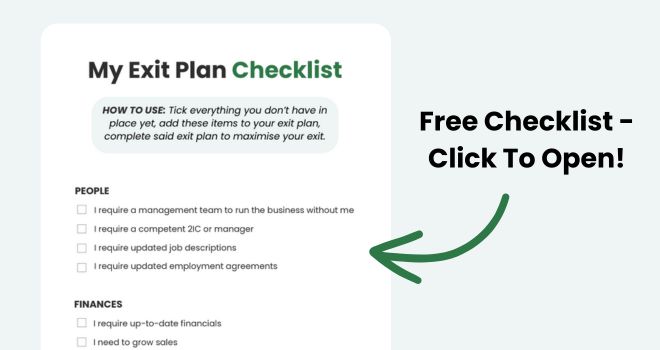
To make this process easy, I have created a checklist that will give you a clear idea of what you need to change and what to include in your Exit Plan.

Simply tick what you require, and those tasks become the parts of your Exit Plan. Check it out below…

So, now that you have completed the checklist, you should have a clearer understanding of what you need to include in your Exit Plan.

Seem overwhelming?… It shouldn’t be.

The best time to start planning your Exit is NOW!.

Begin by putting steps in place to maximise your return when you choose to exit.

(By the way, if you need some assistance with your checklist, simply hit the
“Got a Question” button below – I’d be happy to help).

Righto, in my next email, I’m going to share how to solve a super common exit problem…

How to Remove yourself from Your Business

Until the next one,

HOW to Remove Yourself from your Business…

The MOST important factor that any investor is looking for when buying a business is this:

Does the business run on its own, without a dependency on the business owner?

It’s a simple question. And it’s either a Yes or No answer.

But here’s where it gets tricky…

More often than not, a business will NOT run on its own, because the business owner is either stuck running it themselves, has too much of a say in how everything is done, or is a self confessed control freak, who is too afraid to let go.

If this is you, then change is required. Particularly if you want to exit in the future.

Here’s the good news…

You absolutely CAN remove yourself from the day to day, in a controlled way, that guarantees product quality and happy customers.

At MEA, we do this all the time.

Here’s what needs to happen:

  1. Firstly, understand what it is you do in the business.
  2. Identify the activities that can be transferred to others, trimmed to become more efficient or trashed because they contribute no value.
  3. Delegate out the activities to others (like an Ops Manager, for example).
  4. Create a metric to measure the performance of the activities, and use this to monitor results.

Sounds complex right? Well, it is. Let’s break it down…

Understand what it is you do in the business

This can be achieved by running a simple task audit. Simply observe what you do EVERY DAY, and capture this information on a spreadsheet. WARNING! You’ll be surprised how wildly inefficient you are. But that’s OK, this is only the beginning.

Identify the activities that can be transferred to others

Here we need to identify the activities that you are doing everyday, that do not need to be done by you. This is usually the hardest part.

When doing this, rank every activity you do as either a high-value activity or low-value activity.

High Value = positive ROI on your time. For example, looking at ways to improve your conversion rate or make the business more profit.

Low Value = little to no ROI on your time. For example, answering phone calls, responding to never ending questions from the team, ordering supplies etc.

Once you have labelled your activities or tasks, then carefully decide which tasks will be delegated to who in your business.

Delegate out the activities to others

For this step, you’ll need to observe your team’s capabilities and skills. Who is capable of taking on your tasks and ensuring they are done correctly?

Our ideal scenario here is to appoint a Manager that can take on your High-Value activities, to keep the day to day operations running. Smaller lower value tasks can be delegated to other team members.

Training here is also critical, so ensure you have sufficient process documentation to allow your new manager and team to complete your existing tasks efficiently.

Don’t be a “seagull” manager and fly over the top while dropping “task-bombs” all over everyone.

Most likely, you’ll need to support and coach your team, until they can perform the tasks as you did. Remember to be patient!

Create a metric to measure the performance

Finally, we need to ensure that our product is still being delivered to our customers, and profits are unaffected.

Setup a metric dashboard that measures key indicators of performance, so you can observe (and possibly correct) performance bottlenecks as they occur. This is also a brilliant way to help share the milestones & targets with your new manager, so they know the numbers they need to reach.

Examples of these may include time indicators, error rates or percentages, labour cost targets or wastage volumes. It really depends on your business .

And that’s it….told you it was possible.

So if you’re craving freedom from your business, or you’re looking for a way to break free and let the business run itself, then give the above a go.

It might be the best investment you make in your business to date!

Seem overwhelming?… It shouldn’t be.

The best time to start planning your Exit is NOW!

Need help with Exit Planning advice? – simply hit the “Got a Question” button below.

Ok, in my next blog, I’m going to share some succession planning GOLD with…

How to Lock in Your Managers Using

One Key Tactic!

Until then,

Join the FREE ExitWise Community!

Learn the secrets of exit planning and maximising your sales price with monthly educational emails and free events.