You acquire companies because you want to diversify your portfolio, and grow the brands you currently hold…
You’re constantly in contact with brokers who present opportunities to you, asking if you would like to invest.
The first thing you would want to know is this:
Does the business make money?
Do sales grow?
Do profits grow?
Is there a growth opportunity in their market?
If the answer was NO to all of the above, then you would move on to the next business.
This makes sense right?
When it comes to planning your business exit, this is a significant consideration.
Nobody will buy a business that is not profitable or growing, so your FIRST priority as a business owner should be to ensure that your sales & profits look healthy.
Think about it…
On the BSale website (as of today) there are 14,708 businesses for sale.
Investors have the choice when it comes to buying businesses.
You want to ensure yours looks attractive and is presented well, but more importantly, is a good investment for the buyer.
Here’s a few things to keep in mind:
> Ensure your sales & profit growth are consistent & sustainable. No crazy fluctuations, as this is seen as a red flag.
>Make sure your sales will continue to grow without you – the business owner. Setup a sales system that works without you BEFORE you go to market.
>Speak with your accountant well before you want to sell. They can assist to make your financial statements presentable to a buyer.
>You generally want between 3-5 years worth of sales history before an investor will look at your business.
So put yourself into your ideal investors shoes, and think about how attractive your business is right now.
Do you need to grow sales for a few more years?…
Or perhaps make some expense reductions to increase your profits?…
By starting NOW, you’re more likely to attract better buyer attention when you’re looking to exit.
Found this helpful?…
Great. Please share it with others you think might benefit from it.
Need help with preparing your Exit Strategy?
Then join our ExitWise Community – and receive a monthly email packed with helpful advice and guidance on how to prepare your business to exit successfully.
When you start entertaining the idea about exiting your business, sometimes your current efforts and exit outcome simply don’t line up…
You’ve most likely spent years working on:
– Sales – Marketing – Making and delivering your product – Hiring and training people – Managing finances & cashflows – Business & profit growth
And that’s great!…
However, that’s become the routine.
Growing a successful business is one thing…
Exiting a successful business is something completely different.
When I first speak with business owners looking for advice on exit strategy, I ask them:
What’s your exit outcome?
Most people have never thought about it.
What I explain to them is that, when we start looking towards a future exit, we need to shift our ‘intention’…
From that of business growth…
To preparing the business for an EXIT.
How is this different?…
The former focuses on:
– Sales – Marketing – Making and delivering your product – Hiring and training people – Managing finances & cashflows – Business & profit growth
While preparing for exit focuses on:
– Removing yourself – Building a delivery system that runs on its own – Preparing finances so they are attractive – Creating a sales & marketing funnel that generates leads on autopilot – Managing customer diversity – Ensuring compliance – Lifting company value
As you can see, our list of priorities and objectives is very different.
Once you commit to planning your exit strategy, what you work on in your business should change.
So my question is…
What’s your Intention?…
Your answer will determine what you do next.
Found this helpful?…
Great. Please share it with others you think might benefit from it.
Need help with preparing your Exit Strategy?
Then join our ExitWise Community – and receive a monthly email packed with helpful advice and guidance on how to prepare your business to exit successfully.
When I speak to business owners about sales, I usually get the same feedback…
I ask things like:
Who is responsible for sales in your business?
If you’re not around, who does the selling?
Do you know what your conversion rate is?
The usual replies are something like:
“Well, I do most of the selling. But that’s ok, I’m probably the best at it.”
*NEWSFLASH*
If you’re the best/only person that sells your products, your business value (and saleability) are at risk.
Why?…
Because if you leave or sell your business, your sales will stop.
Not ideal for an investor.
How we fix this is by creating some structure around your sales process, then using this as your ‘system’ to sell your products, then we hire someone to do the selling for you.
Here’s how we do it:
Firstly, let’s map out the steps you take when speaking to a customer and making a sale. It could look something like this:
Enquiry > Qualify > Quote > Follow Up > Objection Handle > Close
At each step, make a checklist of what you say, how you say it, what you need to show the customer, how to do quotes, what to say at the follow up stage etc. Be as precise as you can when doing this, so that your future salesperson can follow your ‘system’ to replicate the sales experience.
Put your sales process to work, by following your own steps with new customers and new sales. Refine this process as you practice it. Then measure your conversion rate over time. This is important so you can illustrate to a potential investor how well your sales ‘system’ performs.
Use the sales process to train others. If you have salespeople already, re-train them using your perfected sales process, so that they achieve the same conversion rate as you. (you’re the best, remember). Then eventually, you’ll hire a salesperson to replace you, and you’ll have a failsafe ‘system’ that generates consistent results.
The point is, if you don’t have a reliable and repeatable sales process or system that “sells” for you, it’s time you put the above into action.
Found this helpful?…
Great. Share it with a friend in business.
Need help with preparing your Exit Strategy?
Then join our ExitWise Community – and receive a monthly email packed with helpful advice and guidance on how to prepare your business to exit successfully.
Last year I had the privilege of being in an audience and listening to the amazing Red Bull pilot Luke Czepiela…
He’s the guy that landed the Red Bull plane on a small helipad on the top of the 700+ ft Burj Al Arab in Dubai.
What was fascinating about Lukes feat, is that he managed to land a stunt plane onto a circle that was only 27 metres in diameter…
Not only was this a world first, but also a truly remarkable achievement of tactical flying and aeronautical engineering.
But the takeaway that I thought was most astonishing was how many times he practised this feat.
Take a guess at how many practice flights he made? (onto a safer helipad)…
6. No.
60. Not quite.
160. Not even close.
600. Yip, thats it.
Let that sink in for a minute….
Luke stated that he practised the landing 600 times.
Thats 600 times to gear up the plane, get it to altitude, wait for the right conditions, then attempt to land at the right speed, angle and be able to reverse thrust in order to stop.
The stunt took two years to prepare for.
Now, most people give up after 12 attempts? Maybe?..
What I learnt in the room that day, was that if you want to achieve anything decent in life, you must remain PERSISTENT.
The old adage – “If not you first succeed, try and try again” is true.
So if you’re not satisfied with:
– your current sales results – your employees not being awesome yet – your poor lead flow – not being able to find employees – a thousand other issues that occur in business
Remember, that you need to remain PERSISTENT in order to reach the top. (providing you have a strategy and are taking action in the first place)
How many times have you really tried?
It might take 600 attempts. Or more.
Keep going. You WILL get there.
Found this helpful?…
Great. Please share it with others you think might benefit from it.
Need help Preparing your Business to Sell?
Then join our ExitWise Community – and receive a monthly email packed with helpful advice and guidance on how to prepare your business to exit successfully.
A few days ago, I was having a conversation with a client that was experiencing errors in his factory.
Assembly issues…
Quality issues…
Mistakes etc.
There were multiple headaches.
He asked: What KPI’s do I need to measure, to eliminate these errors?
My first question was – Do you have a clear manufacturing Process?
Hmmmm, not really.
What Ive found is that trying to improve a system by purely observing numbers, doesn’t actually work.
Trying to “fix” your process through measurement, is like trying to count the number of squeaks your bike has, as you’re cycling along. Its not the squeaks you should be counting, its the bicycle itself that needs attention.
More often than not, its the PROCESS thats faulty. Thats were we need to start.
Here was my advice to resolve his manufacturing problem:
1. Design a manufacturing PROCESS from end to end. What are the steps? 2. Create a checklist or SOP for each step of that process. 3. Assign accountability to someone to ensure each step is followed correctly 4. Measure what matters (only) throughout the process.
*Note: the measurement part is the last step in this solution. Until you have designed the process, created consistency with a checklist then monitored each step, thats when metrics can be applied.
And, as above, Measure only what Matters. Don’t overcomplicate things with dashboards, meaningless KPI’s and numbers that aren’t relevant.
Keep it simple people.
Found this helpful?…
Great. Please share it with others you think might benefit from it.
Need help Preparing your Business to Sell?
Then join our ExitWise Community – and receive a monthly email packed with helpful advice and guidance on how to prepare your business to sell.
A client of mine is in the process of teaching his employees to SOLVE their own problems….
If you have employees, Im sure you can agree, this is not easy.
He has a senior tradesman that will ask for the answer/solution to almost every issue that he faces…
Is he looking for validation? Maybe.
Is he seeking the answer because he’s too lazy to solve it on his own? Perhaps.
Does he want to avoid responsibility? Possibly.
Whatever the case, when this tradesman consistently interrupts my client, he is costing the factory downtime, eroding any efficiency and causing frustration.
This might be happening to you? People that need to pass every scenario by you, just to make sure they made the right decision.
Enough is enough. Heres how I’m helping my client fix it:
Step 1: When you get another “question” from an employee – ask them straight away…”What do you think you should do?”… then wait.
Step 2: If they are struggling to find an answer/solution, coach them so they can find the answer on their own. Empower them to engage their own problem solving abilities by asking questions, allow them to take responsibility for making a decision and then encourage them to take action on it. DO NOT GIVE THEM THE ANSWER.
Step 3: Repeat the above two steps every time a “question” comes your way.
The only reason why our employees are NOT creating their own solutions is because we haven’t trained them to do so…
And in order for them to think for themselves, we must become the coach, that helps them develop their problem solving skills, so they can make decisions and solve problems confidently, without fear of making the wrong move.
Ideal outcome – you create problem solving super-employees that no longer have a dependancy on you. (Win!)
Found this helpful?…
Great. Please share it with others you think might benefit from it.
Need help Preparing your Business to Sell?
Then join our ExitWise Community – and receive a monthly email packed with helpful advice and guidance on how to prepare your business to sell.
In April this year, I was introduced to Sarah, a business owner who was ridiculously busy. She was stressed, exhausted, and tired of running a business that was totally dependant on her.
On the flipside, Sarah’s business was very successful. It had been trading for over 16 years, had built a great reputation and was highly profitable. But the business owner was the bottleneck. Thats why she was so ‘flat out’.
In fact, she was flat out…
Answering THREE phones a day (yes, three separate phones)
Managing employees
Ensuring her customers got what they wanted.
Doing the marketing
Visiting referral partners
Working in the weekends
Doing 50+ hours a week
Needless to say, this was the norm for Sarah.
In April this year, I was introduced to Sarah, a business owner who was ridiculously busy. She was stressed, exhausted, and tired of running a business that was totally dependant on her.
On the flipside, Sarah’s business was very successful. It had been trading for over 16 years, had built a great reputation and was highly profitable. But the business owner was the bottleneck. Thats why she was so ‘flat out’.
In fact, she was flat out…
Answering THREE phones a day (yes, three separate phones)
Managing employees
Ensuring her customers got what they wanted.
Doing the marketing
Visiting referral partners
Working in the weekends
Doing 50+ hours a week
Needless to say, this was the norm for Sarah.
The Painful Truth…
Sarah contacted us because she wanted to prepare her business to sell.
But the painful truth was…..her business was effectively unsellable.
Because it relied solely on her, no buyer will ever front up the investment.
After speaking to her for about an hour, I pulled out a pad and designed an exit plan, right in front of her, that would not only remove herself from the business, but also improve the value at the same time.
This is what I included in that exit plan:
Remove Sarah from the day to day
Identify Sarah’s high/low value activities – prepare to delegate the low value tasks
Get clear on the roles of her employees
Review Employment Agreements
Promote the Office Admin to Office Manager
Review the Org Chart
Get clear on Sarahs time and priorities
Build internal Processes that work on their own
Review all internal operating processes – End to End Delivery Process, Sales process, Lead Acquisition process – everything.
Streamline the E2E Delivery Process and utilise current software to automate.
Build checklists for each step in the process
Review Sarah’s software and capabilities
Re-design the sales & lead acquisition processes so they can be performed by others.
Outsource the Marketing
Review the database
Measure Everything
Get clear on what we need to measure within the E2E Process – what KPI’s matter?
Set sales targets for the team to reach
Set monthly sales targets for the business to reach, in order to grow sales month on month
Financial, Legal & Compliance
Perform Financial Assessment
Expense overview and expense reductions where possible
Create budgets and forecasts for next FY (bookkeeper to assist)
Identify Growth Opportunities
Review legal & governance considerations
After sharing the plan with Sarah, she jumped at what I had scribbled out and we got to work immediately.
The Results…
Now things look very different for Sarah’s business…
She delegates out the small stuff, works about 10 hours a week and her business is growing month on month. She now spends her time working on incrementally improving sales & profits, recruiting a GM to take her place, and intends to list her business for sale at the end of the financial year.
And guess how long it took to make her business saleable and dramatically improve its value….
…only 6 months!
Why am I sharing this success story…
Because if it can happen for Sarah, it can happen for you!
Imagine this: You’re free from the daily business chaos, your company’s value is soaring, and you’re on the path to a lucrative exit.
That’s exactly what Sarah achieved – and you’re next!
If you’re:
> Buried under daily tasks?
> Dreaming of a profitable exit?
> Ready to skyrocket your business value?
Then 2025 is YOUR year to break free. Don’t just dream about it – make it happen!
Click below to schedule your confidential exit call in 2025.
When the moment strikes that you begin to start thinking about how to exit your business, you will generally have many questions…
How much is my business worth?
How do I sell it?
What does that process look like?
What do I need to prepare?
Is my business sale ready?
Will the sale fund the rest of my life?
All valid questions.
However, most business owners seek the answers to these questions from a BUSINESS BROKER.
Guess what?…
A Business Broker wants to SELL your business, not necessarily work with you to prepare an exit plan, to make it sale ready. (I know because I get referrals from brokers all the time)
The best person to direct these questions to is an Exit Advisor.
An Exit Advisors job is to help identify areas of risk and opportunity in your business, tailor an exit plan to help remove the risks and in turn, lift the value of your business making it more attractive to potential investors.
What You Need to Know…
With this in mind, I thought I’d share FIVE critically important factors you MUST address before you begin the process of preparing your business to sell.
1. Manager on Deck: Who Runs the Ship When You’re Not Around?
A manager who can effectively run your business in your absence is a key player in making your business more attractive to buyers. Buyers typically prefer a business that doesn’t rely on the owner for day-to-day operations since it minimises transition risks.
If you don’t have a manager, it might be time to consider promoting one of your team members or hiring externally.
2. Show Me the Money: Do Sales and Profits Grow Each Year?
In reality, reliable and growing sales and profit trends are like catnip for business brokers and potential buyers. Before you think about selling, analyze those financial statements. Better yet, get your accountant on board, to help do some of the heavy lifting.
Highlight areas of growth and identify trends. A business that demonstrates consistent financial growth is always more attractive, reducing perceived risk for buyers.
3. Customer Service on Repeat: Is Your System Reliable and Repeatable?
Let’s be honest — potential buyers love a well-oiled machine. Do you have processes that are reliable and repeatable? Systems that promise consistent customer experience can elevate your business’s value.
Whether it’s how sales are processed, customer service is delivered, or inventory is managed, ensure these processes are documented and streamlined. This reassures buyers that the business can continue operating smoothly after they take over, even without your personal touch.
4. Don’t Put All Your Eggs in One Basket: Variety of Customers
Your sales shouldn’t look like a single customer’s shopping list. Diversification is the name of the game. Evaluate if you have a wide base of customers contributing to your sales or if a significant portion comes from just a few.
A diversified customer base reduces risk and enhances your business’s value. Consider strategies to broaden your number of customers if most of your revenue is from just a handful of clients.
5. The Great Business Exit: Timing Is Everything
An exit strategy isn’t just about walking away and remembering to take your favourite coffee mug. It’s essential to have a well-timed and thought-out plan. When do you plan to exit your business? Have you defined your financial goals?
Knowing these answers can help you streamline preparations and align with market conditions, putting you in the driver’s seat when negotiating the sale.
Your next move…
As you consider these factors, keep in mind that preparing your business for sale is like prepping for a photo shoot — you want everything to look its best.
And, to make it even easier for you, I’ve compiled the above into a handy e-guide that you can download below:
Does the above seem overwhelming?… It shouldn’t be.
Does the above seem overwhelming?… It shouldn’t be.
The best time to start planning your Exit is NOW!
If you need help with Exit Planning advice, or have a question about the exit process, simply hit the “Got a Question” button below.
Ok, in my next email, I’d like to share how I helped a client recently go from answering THREE phones a day to working less than 10 hours a week (in under 6 months)
Every business at its core, runs on some sort of an operating ‘system’. Once a customer places an order, the business ‘system’ proceeds to make the product or produce the services, deliver this to the the customer and satisfy them enough for them to pay for it.
Within this operating system, is usually a set of steps or procedures, that employees follow in order to maintain some level of consistency and standardisation in delivery of the product.
This all makes sense.
But what doesn’t make sense is how often, seemingly simple actions turn into repeatable mistakes, that lead to frustration, pain and dissatisfied customers. This results in stress on the business owner, inefficiency, and eroding profits.
Recently, I had a conversation with a business owner that runs a successful cabinet making business. He has a handful of clients, does work all over Australia and is usually flat out.
During a call one week, he expressed his pain in having to double handle what was happening in his factory and how the onsite teams were constantly calling back to the factory for various reasons.
I listened to what my client had said, and then I asked him…
Do you have checklists for what the team do in the factory?
His response… “Well, sort of?”
Im sure you can agree, this scenario is common among busy businesses and might even happen to you on occasion.
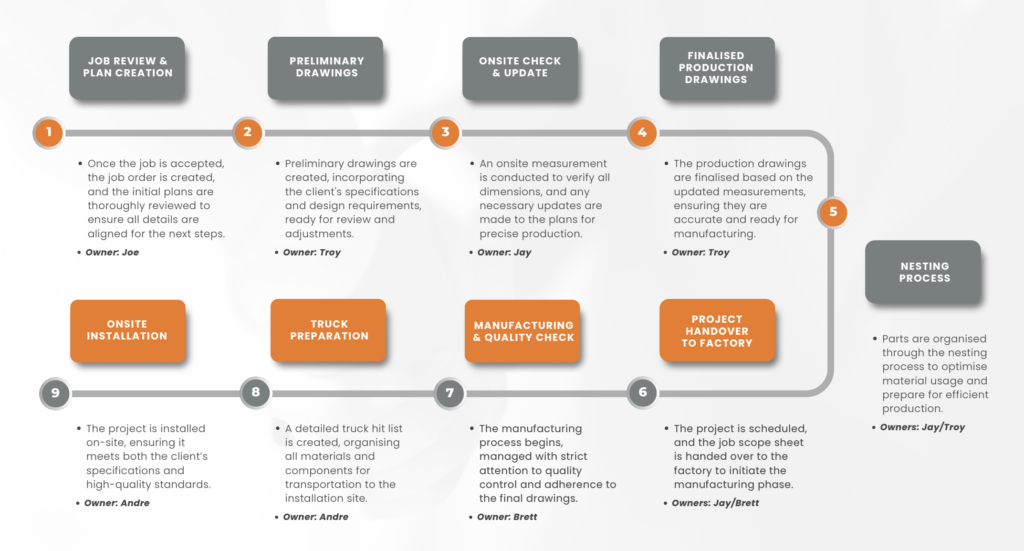
I explained that what we should do, was break down his cabinetmaking process into steps and then safeguard it by creating a checklist that was completed at every step.
This is what it looked like…
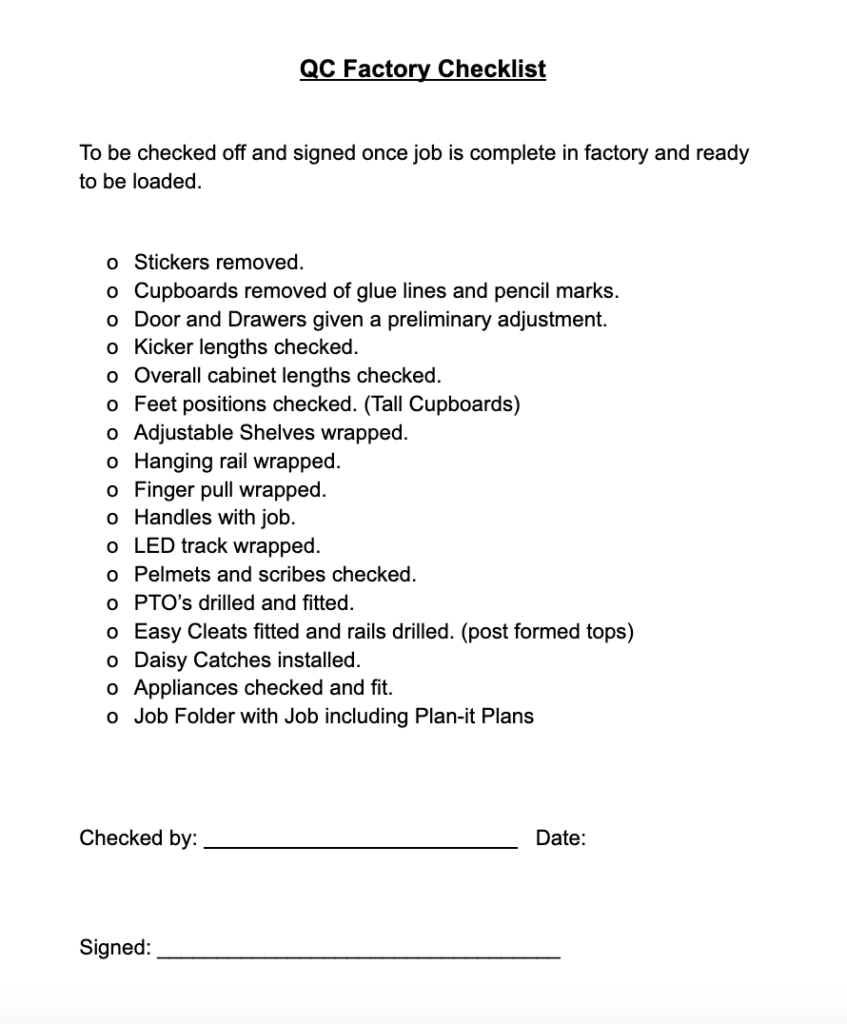
At every step, we then created a simple checklist, that highlighted what important tasks and responsibilities were required for that step.
As you can see, we also assigned an employee to monitor the checklist at each step. It was their role to “tick” the list off, before handing it to the next person.
Heres a snapshot of one of the checklists:
The Results…
We rolled this out to the team, and waited for the results…
Within two weeks, my client noticed a significant reduction in error rates, each step was being completed successfully, there were no more onsite installation headaches and the team stepped up and took responsibility.
I checked in to see how things were going. My client expressed his happiness to me:
“Chris, the difference between a fortnight ago and now, is like night and day. All the pesky phone calls and little problems I had to deal with have disappeared. Its such an improvement!”
Now his ‘system’ is running smoother than ever before and he can focus on more important things.
What Checklists can do for you…
I see this scenario time and time again. A system that is sort of “clunky” and is void of responsibility. It relies too heavily on an individual and not heavily enough on the system to produce the result.
When it comes to preparing a business to sell, you need a robust system that delivers consistent products and results, that is repeatable and can be performed by anyone (skill dependant).
The easiest way to guarantee this is by creating and implementing checklists into your operating system.
A checklist will provide you and your business:
Consistency
Standardisation
Autonomy
Repeatability
Happy customers
Less stress
Versatility – knowing that anyone can follow it
Certainty – for an investor looking to identify any risk in your ability to serve your customers, now & in the future.
The BEST part about a checklist, is that they are simple, fast to produce and implement and act as a guide for others to follow.
In his book “The Checklist Manifesto: How to Get Things Right”, by Dr. Atul Gawande, he states that checklists help prevent common mistakes with serious consequences. They are designed to be short, clear, and focused on the essentials. As Gawande puts it, “Good checklists are, above all, practical”.
Your next move…
If you’re thinking of selling your business in the future, or have started the preparation to do so, getting your checklists right, are a fantastic move to lifting the saleability and value of your business.
And above all else, they’ll even make your life easier in the process!
Does the above seem overwhelming?… It shouldn’t be.
The best time to start planning your Exit is NOW!
If you need help with Exit Planning advice, or have a question about the exit process, simply hit the ‘Got a Question” button below.
When growing a successful business, you NEED people. Scaling without people is pretty difficult…
Even if you’re an online business, at some point, you’ll still need more people to satisfy customers, do more marketing, manage accounts etc.
The hard part is finding that top talent in the first place. Hiring is hard work, particularly in todays environment.
In fact, a recent article from Workable states that it takes an average of 42 days to fill a position. Thats a lot of downtime when you need the right person in the right role.
With this in mind, it makes perfect sense then, to retain your best people for as long as possible. When planning for exit, this is also true, as your people will become the operating force that continually delivers your product, so you can evetually step away.
So how do we retain them?…
Theres a myriad of options to help them stick:
Incentive programs
Bonus structures
Paying them handsomely
Profit sharing (though this can become tricky at sale time)
Professional development programs
Paid training
Retention plans that include flexible working arrangements, investment in culture and social events.
Many of these work, however, it takes a well crafted strategy and fabulous execution to ensure it works correctly and you end up with happy employees…
Its also worth noting that businesses that DON’T invest in their people are the most at risk.
The best of both worlds…
I feel that the best tactic a business owner can use is that of a combination of TWO compensation style rewards.
> One that rewards current performance
> One that rewards loyalty
This way, your employees receive immediate gratification for the hard work they put in over 12 months AND for the dedication they give to the business in the long term.
Heres how it looks:
Rewarding Current Performance
This one is the easier of the two to manage and deploy. Firstly, get clear on the targets that you wish for your employees to achieve, then tie a corresponding bonus to that target.
This could be a percentage or a dollar value, and is best either paid quarterly or at the end of the year.
Rewarding Loyalty
For loyalty, you want to incentivise your team to stay with you, and earn as the company grows.
For this, put aside a separate amount of funds, labelled for each employee of your choosing, and continue to do this for three years.
Then after year three, they are able to withdraw up to a third of the fund, every year, as it continually grows.
For example:
Yr 1 – Create fund and contribute $1000 per employee
Yr 2 – Add in another $1000
Yr 3 – Add in another $1000 + employee can withdraw $1000, (on top of their performance bonus) therefore leaving $2000 in funds for the future.
Obviously you can adjust the fund amount to suit your business, and you could even align the amount with the performance bonus you have started.
The kicker?…
If they ever decide to leave, the funds remain with the business and they’ll be walking away from potentially three years worth of bonuses.
The benefit here is your employee is consistently rewarded for longevity in the business and have already committed three years of service before they are able to access their first payout.
You could also up the ante, and add the funds into a high interest account, so their funds grow and the payout figure increases over time. (Confirm this with your accountant first!)
Of course, you can adjust this concept to your liking, but its a great start in the right direction.
Thats it. Instead of trying to lock in your top performers with only ONE option, try blending a juicy combination of two, that rewards current hard work, matched with hard work over time.
Overall, its a Win – Win – Win scenario!!
Does the above seem overwhelming?… It shouldn’t be.
The best time to start planning your Exit is NOW!
If you need help with Exit Planning advice, or have a question about the exit process, simply hit the ‘Got a Question” button below.